Economic update Q3 2026
Andy Burnham has stepped into his new role as Prime Minister amid a more turbulent geopolitical backdrop in the Middle East, meanwhile the country is waiting to find out how he intends to deliver UK economic growth.
Key facts
- Andy Burnham’s first act as Prime Minister was to appoint John Healey as his Chancellor, a move which did not cause too big a reaction on the money markets. More details will emerge in the coming months on how the new PM and Chancellor will balance the books in the Treasury.
- Mr Burnham has pledged to stick to Labour’s 2024 manifesto not to raise the main rates of income tax, VAT or employee National Insurance, so it seems likely that other forms of taxes, especially wealth taxes and property taxes will come under the microscope.
- The global economic backdrop is growing more challenging with the resumption of hostilities in the Middle East, which has driven up the cost of oil, and the cost of borrowing.
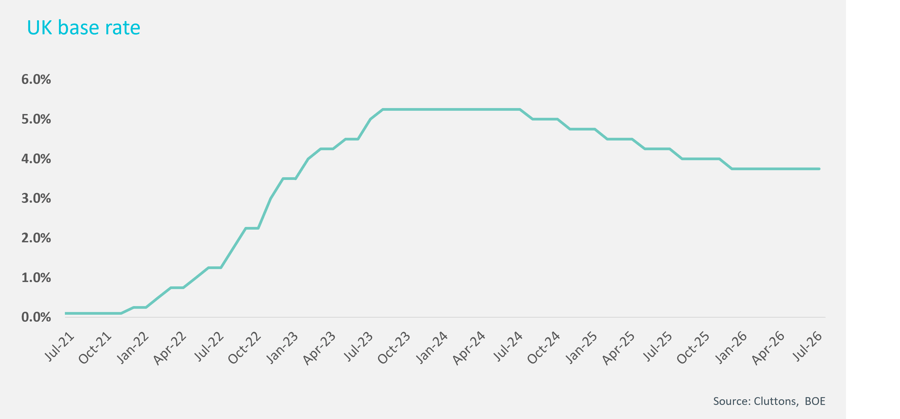
- The Bank of England held the base rate at 3.75% in mid-June. If the US and Iran can move towards a ceasefire and a peace deal once more, then rates are likely to stay steady before potential declines next year. But if hostilities continue then the chances of a rate rise start to increase.
Andy Burnham, the UK’s new Prime Minister, stepped into Number 10 against a much more volatile geopolitical backdrop than has been evident in the last few months.
The ceasefire agreed by Iran and the US as part of the Memorandum of Understanding signed in mid-June seems to have ended. While the ceasefire was in place, oil prices dropped sharply as more ships started to move through the Strait of Hormuz. In the UK, gilts rates also fell back, and borrowing rates also declined, with many mortgage lenders cutting their rates.
However, hostilities between Iran and the US have ramped up once again since mid-July, creating global uncertainty and pushing up oil prices and borrowing rates.
Donald Trump has also moved to ramp up tariffs again on imports into the US. The UK’s tariff will not change, but the EU tariff has been reduced from 15% to 10%, and, due to the agreements already made between the EU and the US, the EU now has a slight edge over the UK on some products.
Closer to home, Mr Burnham has outlined some bold plans on how he plans to overhaul how policies are implemented across the country, with a real focus on devolution and empowerment of Mayoral Combined Authorities.
There was much speculation around who would be named Chancellor, with fears that any inhabitant of Number 11 who wanted to use borrowing to pay for spending would elicit a negative response from the bond markets. In the end, Mr Burnham’s choice of John Healey seems to have appeased the markets with the yield on 10-year gilts remaining largely unchanged in the days after his appointment.
There is likely to be further speculation around Mr Burnham’s new policies over the summer. He has pledged to stick to Labour’s 2024 manifesto pledge not to raise the main rates of income tax, VAT or employee National Insurance, so it is likely that property and wealth taxes will be closely examined. Angela Rayner has returned to her post as Secretary of State for Housing, Communities and Local Government, while Matthew Pennycook remains as Housing Minister – a welcome bit of continuity for the housing brief which has had an even faster revolving door than Number 10 over the last decade. With two years in post, he is now the longest-serving Housing minster for a decade.
Meanwhile the UK economy performed slightly better than anticipated in May, with GDP rising by 0.1%. This data signals 0.4% quarterly growth in Q2. However, with an expected uptick in inflation in the coming months, the likelihood is there will be little economic growth to cheer the new Government in Q3, with Capital Economics forecasting 1% annual GDP growth across the year as a whole in 2026.
CPI inflation remains flat at 2.8% in May, but core inflation ticked up from 2.5% to 2.6%. Inflation is not expected to climb back to the double-digit rates recorded after Russia’s invasion of Ukraine in 2022 even with the ongoing conflict in the Middle East. But a prolonged war will add further upward pressure to prices, with higher oil costs gradually filtering through to goods across the economy.
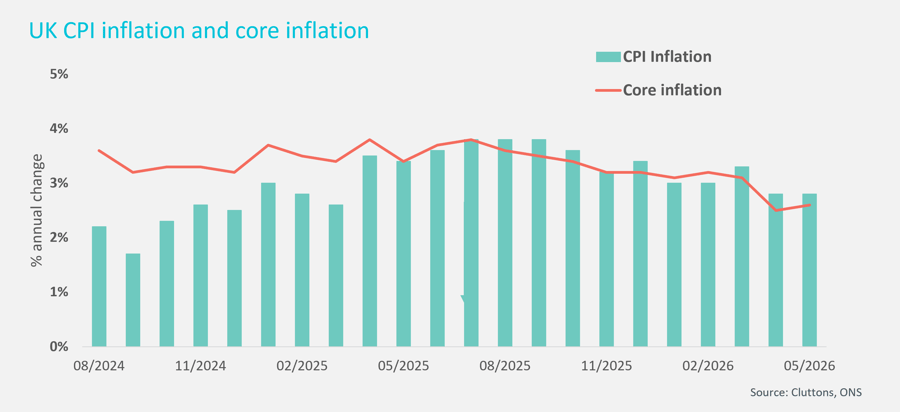
The Bank of England kept Bank Rate on hold at 3.75% in June, but with the war in the Middle East, it will be keeping a close eye on oil prices and inflation. It is unlikely to make any sudden moves to raise rates, but if the conflict continues expect the language from the central bank to become less benign.

The information provided in this report is the sole property of Cluttons LLP and provides basic information and not legal advice. It must not be copied, reproduced or transmitted in any form or by any means, either in whole or in part, without the prior written consent of Cluttons LLP. The information contained in this report has been obtained from sources generally regarded to be reliable. However, no representation is made, or warranty given, in respect of the accuracy of this information. Cluttons LLP does not accept any liability in negligence or otherwise for any loss or damage suffered by any party resulting from reliance on this publication.
Sign up to receive our research
Register here if you would like to receive our research direct to your inbox.
Cluttons produce quarterly research on both the residential and commercial markets. We also produce an annual report on the importance of digital connectivity and the infrastructure needed to provide it.