Prime London & UK sales market update Q3 2026
Prime London house prices continued to soften in Q2, with values down 3.1% year-on-year as higher borrowing costs, geopolitical uncertainty and potential tax changes weighed on market sentiment.
Key facts:
- Average prime London values continued to fall in Q2, with prices down -3.1% in the year to the end of June compared to a -2.7% annual fall in Q1
- Prime central London prices fell -4.9% in the year to the end of June, and are down -7.3% over the last five years
- There is activity in the market, but the downward pressure on pricing from higher borrowing costs and past and future tax changes is continuing to feed through, and we now expect a -1.5% fall in prime London prices this year, followed by a slight bounce-back of +1% next year
- These forecasts may change should the tax regime change once again in the Autumn under the new Government
Average prime London home values fell again in Q2, declining by -1.2% in the quarter, the biggest decline since the end of 2022. Prices were -3.1% down on an annual basis at the end of June meaning the pace of decline has gathered momentum, following a -2.7% annual decline in Q1 and a -2.2% annual fall in 2025.
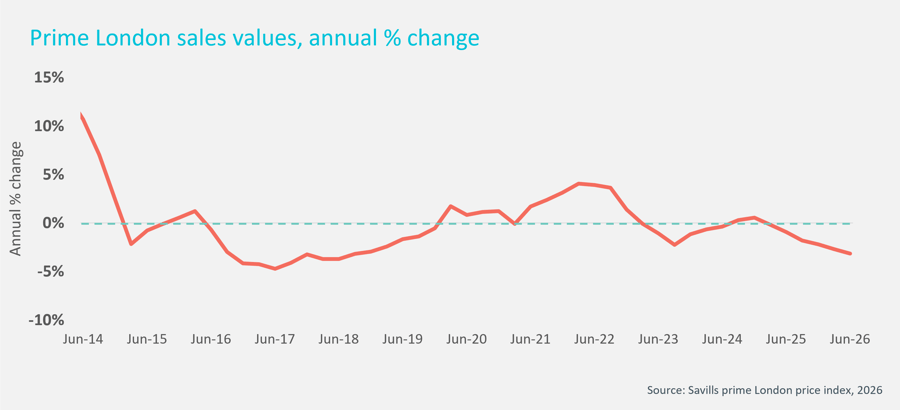
These price movements reflect the trends in the early part of the year as activity rebounded amid indications that prices were nearing a floor, supported by limited availability of the strongest stock and by buyers seeing relative value.
However, the outbreak of the conflict in the Middle East in February and the resulting rise in borrowing rates put pressure on all transactional markets. This pressure has ramped up again in recent weeks as June’s peace deal broke and hostilities broke out again, pushing up borrowing costs and creating more uncertainty.
Greater geopolitical uncertainty will make some discretionary buyers more cautious, potentially extending the time needed to complete deals.
The recent political upheaval in the UK is also weighing on sentiment, as Andy Burnham, the new Prime Minister, has previously supported the idea of increased wealth and property taxes, although no details have yet emerged about what he, or his new Chancellor John Healey, may be planning. More will become clear at the first Budget, expected to be in October.
The prime central London market has a higher proportion of equity buyers, meaning borrowing costs have less impact on pricing or activity. However, this market continues to adjust to the non-dom reforms, especially the inheritance tax changes which came into force last year, which has already prompted some owners to leave the UK.
The market will also be absorbing upcoming tax changes in pricing. The former Chancellor used last year’s Budget to confirm that, from April 2028, properties valued at £2m or above will be subject to the Higher Value Council Tax Surcharge (HVCTS). The annual levy will range from £2,500 to £7,500. Although it has been labelled a mansion tax, earlier versions of such a policy had envisaged an uncapped charge of 1% of a property’s value, making the confirmed surcharge a more limited intervention.
There has been speculation that Andy Burnham is considering lowering the threshold at which the HVCTS is paid to £1.5m, but no formal confirmation of such a move. It would serve to put more downward pressure on pricing in the prime markets.
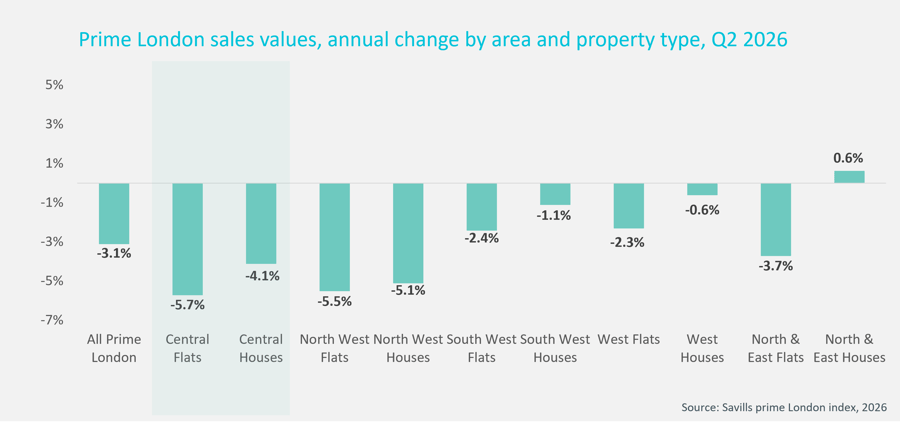
Homes in prime central London have registered some of the largest declines over the last year, with average values for flats down -5.7% on the year, compared to -5.4% in Q1. The pace of decline for house prices also picked up to -4.1% in the year to June, from -4.0% in the year to the end of March.
Given the changing backdrop and upward pressure on borrowing costs, as well as the uncertainty around possible tax changes in the Budget, we expect a more modest performance for prime prices this year, and are downgrading our forecasts to a decline of -1.5% this year, and +1% next year.
Mr Burnham has said in the past that he supports scrapping stamp duty and council tax and replacing them with an annual land value tax (LVT). This would be a very big change, complicated to introduce and administer. The withdrawal of an upfront charge on purchases would likely lead to more activity in the market, but the annual charges for more expensive properties, especially in London, would put downward pressure on values.
However, Number 10 moved quickly this week to deny speculation that this change was under active consideration. This is welcome. Preventing a repeat of the four months of frenzied speculation around property taxes in the run-up to last year’s Budget, and the ensuing drop-off in activity in some parts of the market, will help create stability. This stability will ensure the UK’s housing market can continue to fully function for those who need to move.
UK housing market
In the wider UK housing market, average price growth ticked up to 2.2% in June, from 1.7% in May but down from 3% in February. This easing in prices reflects the wider market uncertainty, and the higher mortgage prices in the market during much of Q2 as swap rates, the fixed-term rates which are linked to mortgage pricing, were pushed up by the events in the Middle East. Activity in the market also eased during Q2, with mortgage approvals falling by 10.6% month on month in May.
Looking forward, just like the prime London market, a return to a ceasefire will ease market conditions. But while hostilities continue, the pressure on borrowers will rise. Five lenders put up their rates in mid-July, an immediate reaction to the higher rates on the money markets caused by uncertainty over oil prices and which direction the conflict is heading.
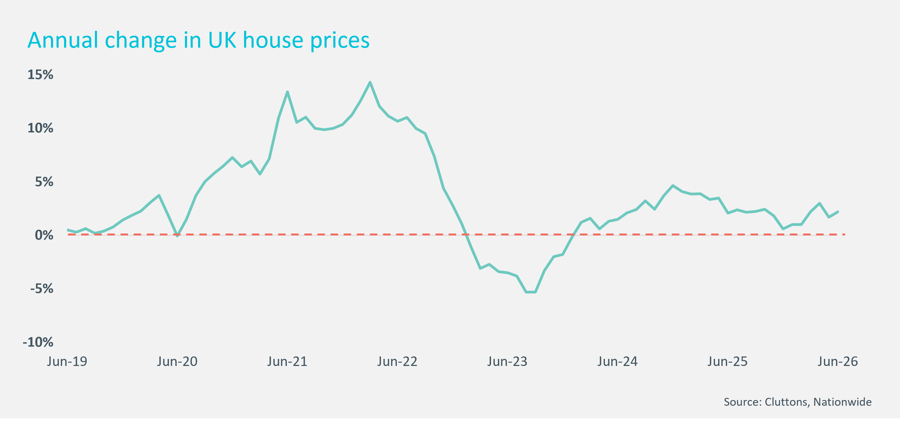
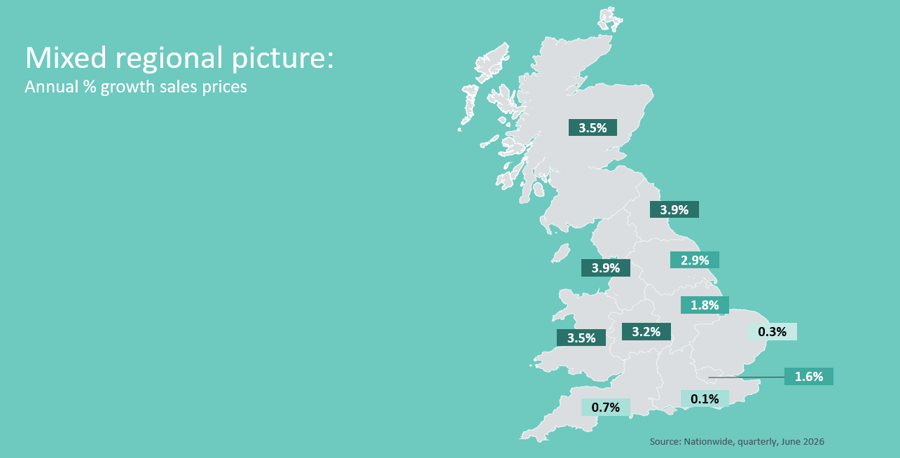
The headline rate of UK house price growth masks significant regional variation. In Q1, the West Midlands, Wales, the North West, the North of England and Scotland all saw above-average price growth, with prices rising from a lower base, and higher levels of affordability. Higher mortgage rates are having a greater impact on affordability in the South of England. Greater London is an exception within the region, with average prices rising by 1.6%. However, prices in London are up just 5.8% from the trough of the market in 2023, compared to a 13.6% rise in the North West.
As highlighted last quarter, a continuation in the Middle East conflict was likely to skew our forecasts to the downside. Given the hostilities have resumed, and with the slowdown in activity more generally, we have revised down our forecast mainstream price growth to +1.5% for this year, returning to +3.5% growth next year, assuming that the Middle East conflict will pause for a long period or end, allowing base rates to start to fall into 2027.
Forecast
| Year | UK House Prices | Prime London Sales Prices | Prime London Rents |
|---|---|---|---|
| 2025 | +1.7% | -2.2% | +2.1% |
| 2026 | +1.5% | -1.5% | +3.0% |
| 2027 | +3.5% | +1.0% | +3.0% |



The information provided in this report is the sole property of Cluttons LLP and provides basic information and not legal advice. It must not be copied, reproduced or transmitted in any form or by any means, either in whole or in part, without the prior written consent of Cluttons LLP. The information contained in this report has been obtained from sources generally regarded to be reliable. However, no representation is made, or warranty given, in respect of the accuracy of this information. Cluttons LLP does not accept any liability in negligence or otherwise for any loss or damage suffered by any party resulting from reliance on this publication.
Sign up to receive our research
Register here if you would like to receive our research direct to your inbox.
Cluttons produce quarterly research on both the residential and commercial markets. We also produce an annual report on the importance of digital connectivity and the infrastructure needed to provide it.